Enlarge
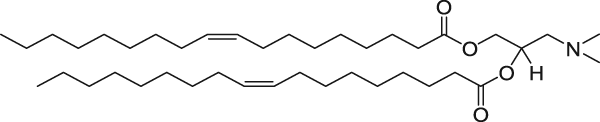
DODMA A89899 (Legacy code 890899) 1,2-dioleyloxy-3-dimethylaminopropane
DODMA is an ionizable cationic lipid used in lipid nanoparticles (LNPs) and cationic liposomes for nucleic acid delivery. Its structure combines a tertiary amine head group with two unsaturated 18-carbon oleyl chains connected through ether linkages.
The tertiary amine gives DODMA its pH-responsive behavior: it becomes protonated under acidic conditions, promoting association with negatively charged nucleic acids, and becomes substantially less charged at physiological pH. That process makes DODMA useful for designing delivery systems that balance nucleic acid encapsulation with particle surface properties.
Application
Researchers can incorporate DODMA into their lipid-based delivery systems for nucleic acids, including:
- siRNA delivery: Supports formulation of particles designed to encapsulate and deliver gene-silencing molecules.
- mRNA delivery: Used as an ionizable lipid component in LNP formulations for messenger RNA research.
- Plasmid DNA delivery: Can be incorporated into cationic liposomes and other non-viral systems for DNA delivery studies.
- Ionizable lipid research: Provides a defined lipid scaffold for investigating how structure and charge behavior affect nucleic acid encapsulation and delivery.
Formulation & handling
Avanti Research™ supplies DODMA at >99% purity in 100mg and 500mg chloroform and oil packaging. Its ether linkages provide greater resistance to hydrolysis than ester-linked lipids, supporting stability during storage for up to one year; store at −20°C. This lipid is not hygroscopic or sensitive to light.
The worldwide scientific and research community has trusted Avanti Research™ for 50+ years to provide high-purity lipids, detergents, and tools that drive their breakthroughs in drug delivery and advancements in membrane and structural biology.
References
Chen, Zhaogang, Aizhen Zhang, Zhaogang Yang, Xinmei Wang, Lingqian Chang, Zhengzheng Chen, and L. James Lee. "Application of DODMA and Derivatives in Cationic Nanocarriers for Gene Delivery." Current Organic Chemistry, vol. 20, no. 17, 2016, pp. 1813–1819, https://doi.org/10.2174/1385272820666160202004348.
Cullis, Pieter R., and Michael J. Hope. "Lipid Nanoparticle Systems for Enabling Gene Therapies." Molecular Therapy, vol. 25, no. 7, 2017, pp. 1467–1475, https://doi.org/10.1016/j.ymthe.2017.03.013.